The Truth About High Resolution Audio
For years, I chased the elusive promise of high resolution audio, convinced that higher bitrates meant objectively better sound. What I uncovered in the GlowRig lab challenges almost every marketing claim you’ve ever read.
I once bought into the marketing hype surrounding high resolution audio. Like many, I believed that simply acquiring a DAC and playing 24-bit/192kHz files would instantly unlock an auditory nirvana. My initial experiments, however, yielded results that were, frankly, underwhelming. It wasn't until I meticulously rebuilt my entire signal chain and critically evaluated the human element that the true picture of high resolution audio emerged. This isn't about incremental gains; it's about understanding a system, a science, and your own perception.
The High-Res Mirage: What I Learned in the Lab
The industry narrative often paints a simplistic picture: more bits and a higher sample rate equate to unequivocally superior sound. This leads consumers to invest heavily in single components—a 'hi-res certified' player or a pair of expensive headphones—only to find the tangible improvements negligible. We've seen countless users report this frustration. The problem isn't necessarily the technology; it's the isolated focus on one part of a complex system, and a profound misunderstanding of auditory physiology. My own early tests were flawed by this exact tunnel vision, chasing a spec sheet rather than an experience.
Beyond the Bitrate Hype Cycle
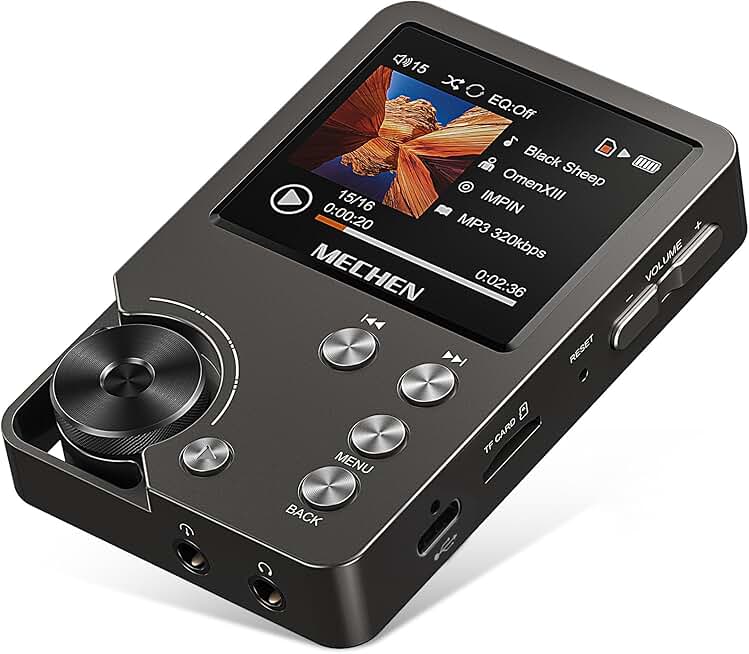
MECHEN M30 HiFi MP3 Player
Premium Pick
- High performance
- Premium build
Most discussions around high resolution audio focus on the numbers: 24-bit depth, 96kHz or 192kHz sample rates. These metrics are critical for recording and mastering engineers, offering greater dynamic range and headroom. For the consumer, however, the audible benefits diminish rapidly beyond CD-quality (16-bit/44.1kHz or 48kHz) under typical listening conditions. The Audio Engineering Society (AES) has published numerous papers on the limits of human hearing, particularly regarding frequencies above 20kHz, which are often the theoretical 'advantage' of ultra-high sample rates. The reality is, a 24-bit file gives you an enormous dynamic range—the difference between the quietest and loudest sounds—far exceeding what most playback environments or human ears can fully resolve without clipping or masking. It's about preserving detail, not necessarily adding more perceived detail at the extremes.
Defining True High Resolution Audio
True high resolution audio, in GlowRig's experience, is not just about the file format. It's about a commitment to signal integrity from source to ear. It means preserving the original recording's fidelity with minimal loss or added noise. This involves a chain where each link is robust: a high-quality digital-to-analog converter (DAC), a clean amplifier, and transparent transducers (headphones or speakers) in an optimized listening environment. It's the absence of degradation, not the mere presence of high numbers. Think of it as a meticulously engineered conduit, ensuring the precious signal arrives undisturbed. This is where most people miss the point. You can't just slap a 'Hi-Res' sticker on a weak link and expect miracles.
The Untapped Potential of 24-bit/192kHz
While the human ear's ability to discern frequencies above 20kHz is limited, and the dynamic range of 16-bit is already vast, 24-bit/192kHz isn't entirely superfluous. Its primary value for the consumer lies in what it prevents: intermodulation distortion and quantization noise. A higher sample rate pushes these artifacts further out of the audible band, making the audible range cleaner. A higher bit depth provides greater numerical precision, which is especially beneficial during digital volume control or any digital signal processing (DSP) applications, preventing truncation errors that can manifest as subtle noise or loss of detail. The real benefit is a more pristine floor for your audio, allowing nuances to emerge that might otherwise be masked by system noise or digital inaccuracies. It's not about hearing more frequencies, but hearing the existing frequencies with greater clarity and less digital veil.
Decoding the Ecosystem: DACs, Amps, & Drivers
To genuinely experience the benefits of high resolution audio, your entire audio chain must be up to the task. The DAC is the bedrock, converting digital bits into an analog waveform. A well-engineered DAC (e.g., those utilizing high-quality ESS Sabre or AKM chips) with low total harmonic distortion plus noise (THD+N) and a high signal-to-noise ratio (SNR) is non-negotiable. Then comes the amplifier. It needs to provide sufficient, clean power to drive your headphones or speakers without introducing its own distortions. Finally, the transducers themselves: your headphones or speakers. They must be capable of accurately reproducing the nuanced dynamics and transient response delivered by the DAC/amp combo. Even the best signal will fall apart if your headphones can't translate it faithfully. For critical listening, look for headphones with a flat frequency response, low impedance (if paired with a powerful amp), and high sensitivity. This is not a place for 'bass-heavy' consumer headphones.
For those seeking a premium, dedicated network audio player to anchor a high-resolution setup, the Cambridge Audio CXN100 stands out. It's a testament to engineering excellence, focusing on meticulous signal processing and robust connectivity to ensure a pristine delivery of your digital files. Its integrated DAC and pre-amp capabilities mean it’s designed to be the central hub for serious listeners, connecting directly to power amplifiers or active speakers.
Engineering Your Signal Chain for Clarity
Achieving true audio clarity involves more than just buying expensive gear. Here’s a tactical approach:
- Source Material: Ensure your files are genuinely high-res and not upscaled. Services like Qobuz or Tidal HiFi offer verified lossless and high-res streams. Local files should ideally be FLAC or ALAC from reputable sources.
- Dedicated DAC: Move beyond your computer's built-in sound card. Even an entry-level external DAC will offer significant improvements. For serious work or listening, a high-quality unit is paramount. Mixing with Headphones: The Ultimate Masterclass 2026 delves into similar fidelity concerns.
- Clean Power: Power conditioning can reduce electrical noise, providing a cleaner foundation for your audio components. This is often overlooked but critical for reducing the noise floor.
- Acoustic Treatment: For speaker setups, room acoustics are as important as the gear itself. Reflections, standing waves, and resonances can utterly destroy the perceived fidelity of any audio. We've discussed this extensively in The Truth About room acoustics Nobody Tells You and how The 'Aesthetic' Acoustic Panel Trap can mislead.
- Critical Listening: Train your ears. True appreciation of subtle fidelity improvements comes with focused, active listening in a quiet environment. Your podcast audio quality will also benefit from this approach.
The Single Biggest High-Res Audio Mistake
The most pervasive mistake I've observed, and one I made myself early on, is investing solely in the source (the high-res file) while neglecting the delivery system and listening environment. People will spend hundreds on a high-res player or a subscription, only to listen through mediocre headphones connected to a noisy laptop's headphone jack in a reverberant room. This is akin to buying a high-performance sports car and only driving it on a dirt road. The potential is there, but the conditions prevent its realization. Your ears, your room, your amplifier—these bottlenecks will negate any theoretical advantage of a 24-bit/192kHz file. Without a balanced, optimized signal chain and a quiet space, the difference between high resolution audio and well-mastered CD quality often becomes imperceptible to the average listener.
GlowRig's Verdict: Is it Worth Your Investment?
Yes, high resolution audio is absolutely worth pursuing, but not for the reasons often touted by marketing departments. It's not about magically hearing frequencies beyond human perception; it's about eliminating noise, preserving dynamic nuance, and ensuring signal integrity throughout the entire playback chain. It’s an investment in a meticulously crafted listening experience, where every component plays a role in delivering the artist's original intent with the utmost fidelity. For the serious audiophile, the content creator, or anyone who values a pristine soundscape, understanding and implementing the principles outlined here will elevate your audio experience far beyond simply buying a 'Hi-Res' badge. Focus on the chain, not just the file.
Frequently Asked Questions
What exactly defines high resolution audio?
High resolution audio typically refers to digital audio files with a higher sampling rate and/or bit depth than standard CD audio (16-bit/44.1kHz). Common formats include 24-bit/96kHz or 24-bit/192kHz, often in lossless formats like FLAC or ALAC. However, true high-res goes beyond file specs to encompass the entire playback system's ability to preserve signal integrity.
Can the average person really hear the difference with high resolution audio?
Under ideal conditions—with a high-quality playback chain (DAC, amplifier, transducers) and in a quiet, acoustically treated environment—many listeners can perceive subtle improvements in dynamic range, clarity, and spatial detail. However, the difference is often less dramatic than marketing suggests, especially if any part of the signal chain is a bottleneck or the listening environment is noisy. It's often about the absence of degradation rather than adding new information.
What equipment is essential for a high resolution audio setup?
To fully appreciate high resolution audio, you need three core components: a source capable of playing high-res files (e.g., a dedicated player or streaming service), a high-quality Digital-to-Analog Converter (DAC) to accurately convert the digital signal, and a clean amplifier paired with transparent headphones or speakers that can accurately reproduce the sound without introducing distortion. Acoustic treatment for speaker setups is also crucial.
Is streaming high resolution audio worth it?
Yes, streaming high resolution audio from services like Qobuz or Tidal HiFi can be highly rewarding, provided your internet bandwidth is sufficient and your playback equipment can handle the higher data rates. It offers convenient access to vast libraries of high-fidelity music without needing to manage large local files, making it a viable and often superior alternative to standard streaming quality.
Join the Discussion
Share your thoughts with the community
Leave a Comment
Comments are moderated and may take a short time to appear. Links are not permitted.